


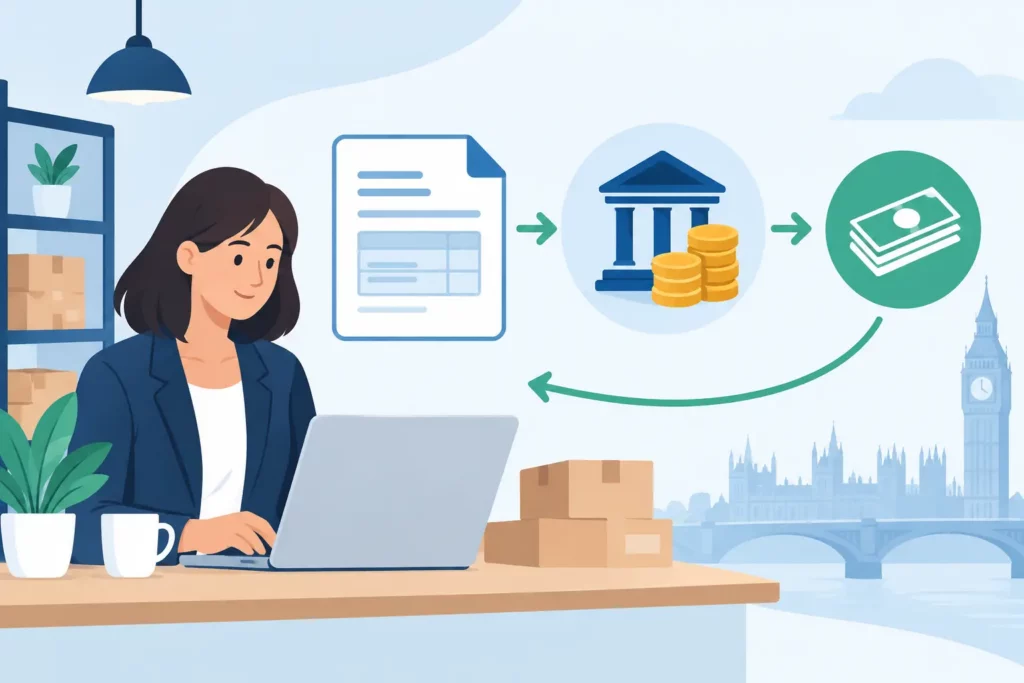
A profitable business can still run short of cash when customers take 30, 60 or 90 days to pay. How does invoice finance work in that situation? It allows you to release much of the value tied up in eligible unpaid invoices, rather than waiting for your customer’s payment date.
For many UK SMEs, this can make the difference between taking on a new contract with confidence and turning work away because wages, suppliers or VAT fall due first. It is not a loan in the traditional sense, and it is not right for every business. The value lies in understanding how the facility operates, what it costs and how it will affect your customer relationships.
How invoice finance works step by step
Invoice finance is a working-capital facility secured against your outstanding business-to-business invoices. Once you have supplied goods or completed an agreed service, you raise an invoice as normal. Instead of waiting for the customer to pay, the finance provider advances an agreed percentage of that invoice’s value.
The process normally follows a clear pattern. You issue an invoice to a creditworthy business customer, submit it to the finance provider and receive an initial advance, often between 70% and 90% of the gross invoice value. The exact percentage depends on your trading history, invoice profile, customer quality and the provider’s assessment of risk.
Your customer then pays the invoice when it falls due. Once payment has been received, the provider releases the remaining balance, known as the retention or reserve, after deducting its fees and any interest or discount charge.
For example, imagine you issue a £20,000 invoice with an 85% advance rate. You could receive £17,000 shortly after the invoice is approved. When your customer pays the £20,000, the remaining £3,000 is released less the agreed charges. That gives you earlier access to cash that your business has already earned.
The facility usually grows and reduces alongside your sales ledger. Raise more eligible invoices and more funding may become available. If sales slow, the available facility will normally reduce too. This is why invoice finance can be more flexible than a fixed-term loan for businesses with fluctuating turnover.
Invoice factoring and invoice discounting
The two main forms of invoice finance are factoring and discounting. Both are based on the value of unpaid invoices, but they differ in who manages the credit control process and whether customers know a funder is involved.
Invoice factoring
With factoring, the finance provider usually manages collections and credit control on your behalf. Your customers are normally told that the invoices have been assigned to the provider and pay into a designated account.
This can suit a business that wants support chasing payments or does not have an established credit-control team. It may be particularly helpful where late payment is creating a persistent administrative burden. The trade-off is that your customers will generally be aware of the arrangement, so choosing a provider with a professional collections approach matters.
Invoice discounting
With invoice discounting, you retain responsibility for collecting payment from customers. Confidential invoice discounting means customers may not know you are using a finance facility, although the lender will still monitor the ledger and may require payment to go through a controlled account.
This option is often used by larger or more established businesses with reliable accounting systems and confident internal credit control. It can give you more control over customer communication, but it also places more responsibility on your team to collect promptly and keep the provider updated.
There are also selective facilities, where you fund individual invoices rather than your whole sales ledger. This can be useful for a one-off large invoice, a seasonal cash requirement or a business that does not want to commit every customer account to a full facility.
What does invoice finance cost?
The cost is not limited to one headline rate, so it is worth looking carefully at the full pricing structure. Most facilities include a service fee for managing the arrangement and a discount charge, which works in a similar way to interest on the money advanced. The longer an invoice remains unpaid, the more the discount charge is likely to be.
There may also be arrangement fees, audit fees, minimum monthly charges, renewal fees or fees linked to funding individual invoices. The cheapest-looking advance rate is not always the best deal if the contract has restrictive minimums or charges that do not reflect how your business trades.
A useful comparison considers the total cost, the advance rate, contract length, notice period, concentration limits and the level of customer service. A facility that provides less than the maximum advance can still be the better commercial choice if it has fairer terms and fits your cash-flow pattern.
Recourse, non-recourse and bad debts
Most invoice finance is provided on a recourse basis. This means that if a customer does not pay within an agreed period, usually because of a dispute or insolvency, your business may need to repay the advance or replace that invoice with another eligible one.
Non-recourse finance or bad debt protection can reduce the impact of a customer insolvency, subject to the policy terms and credit limits agreed by the provider. It does not normally cover every reason for non-payment. If a customer disputes the goods, service quality or delivery, the invoice may still be ineligible until the dispute is resolved.
This distinction matters. Invoice finance improves the timing of cash receipts, but it does not remove the need for sound credit control, clear contracts and accurate invoicing. Before entering a facility, consider how often customers query invoices, whether you have a small number of major debtors and how dependent you are on any one account.
When invoice finance can be a good fit
Invoice finance tends to work best for businesses that sell to other businesses on credit terms and have a regular flow of invoices. It is commonly used by recruitment firms, wholesalers, manufacturers, transport businesses, professional services firms and contractors, although suitability depends on the individual trading model.
It can be particularly useful when growth creates a cash gap. A larger order often means buying more stock, taking on staff or paying subcontractors before the related invoice is settled. Rather than using all available cash or waiting for a conventional loan decision, funding against invoices can help match cash availability to trading activity.
It may be less suitable where invoices are raised to consumers, work is highly contractual or milestone-based, customer disputes are common, or the business has only a very small number of debtors. Providers will also review the strength of your customers, invoice ageing, sector, turnover and the quality of your financial records.
Questions to ask before agreeing a facility
The right facility should support your trading, not create another management problem. Ask how much of each invoice can be advanced, when funds will be available, who will contact your customers and what happens if an invoice is paid late or disputed.
You should also understand whether there is a personal guarantee, a debenture or another form of security. While invoice finance is primarily secured against the debtor book, security requirements vary between lenders and depend on the business, facility size and risk profile.
Pay close attention to the contract term and termination provisions. A facility with a long minimum period, high minimum fee or substantial exit charge can become expensive if your circumstances change. Transparency at the outset gives you more control later.
A specialist adviser can help compare lender appetite, structure a facility around your debtor book and explain the terms in plain English before you commit. Winchester Corporate Finance works with businesses to assess whether invoice finance is the right route or whether another form of working-capital funding would provide a better fit.
The practical next step is to look at your aged debtor report alongside your upcoming commitments. If good invoices are consistently waiting to be paid while your business needs cash to deliver the next piece of work, invoice finance may turn that gap into a manageable funding plan.